Maidenhair-tree
Ginkgo biloba
Ginkgo family (Ginkgoaceae)
 Endangered










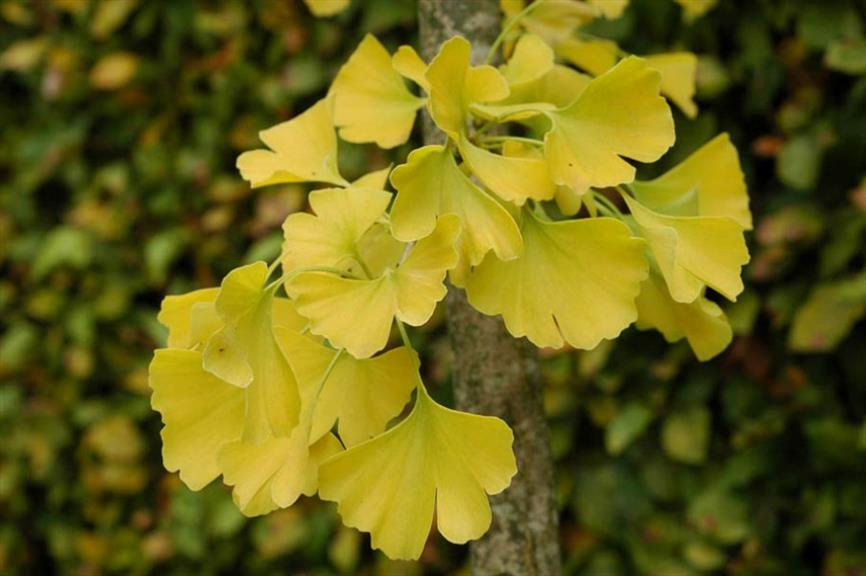
Odouriferous fan leaves
Unmistakable, with each leaf subdivided into two lobes and veins becoming finely divided like a little fan, the ginkgo is the last surviving species of the Ginkgoales. This order of plants grew across the northern hemisphere throughout the Mesozoic Era (250 to 60 million years ago) and comprised many species. The fruits of the female tree produce a revolting odour similar to that of rancid butter.
The ginkgo comes from China and was probably introduced to Japan 800 years ago by Buddhists. Monks grew this tree around their temples. The oldest specimen in Europe is located in the garden of the Utrecht University Museum and has been growing there since 1730. An extract from the leaves is used as a medicine to improve blood circulation.
Read more.... »Present in:
Hortus Botanicus AmsterdamHortus Alkmaar
Historische Tuin Aalsmeer
Hortus botanicus Leiden
Botanische Tuinen Universiteit Utrecht
Landgoed Schovenhorst
Botanische Tuin Arboretum Oudenbosch
Botanische Tuin Kerkrade
Pinetum Blijdenstein
Hortus botanicus Haren / Groningen
Arboretum Poort Bulten
Botanische Tuin De Kruidhof
ARTIS








Themes
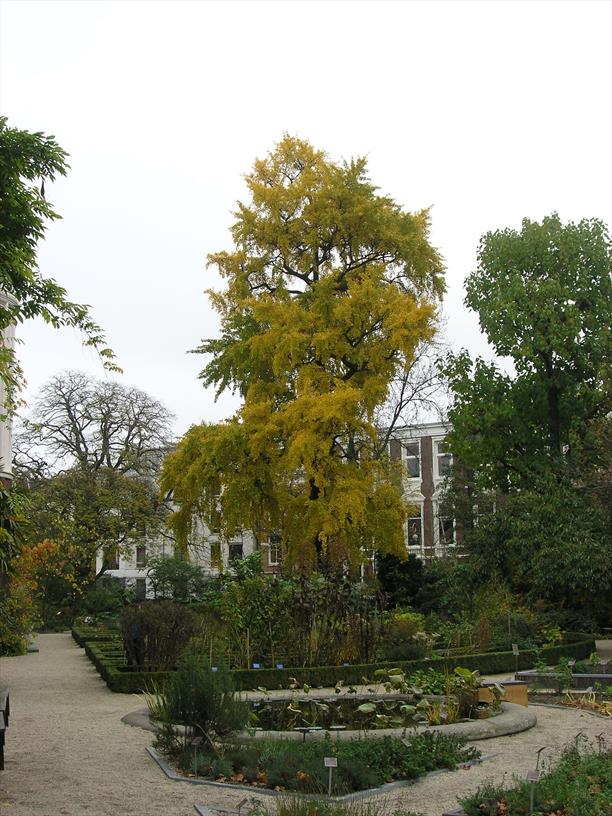
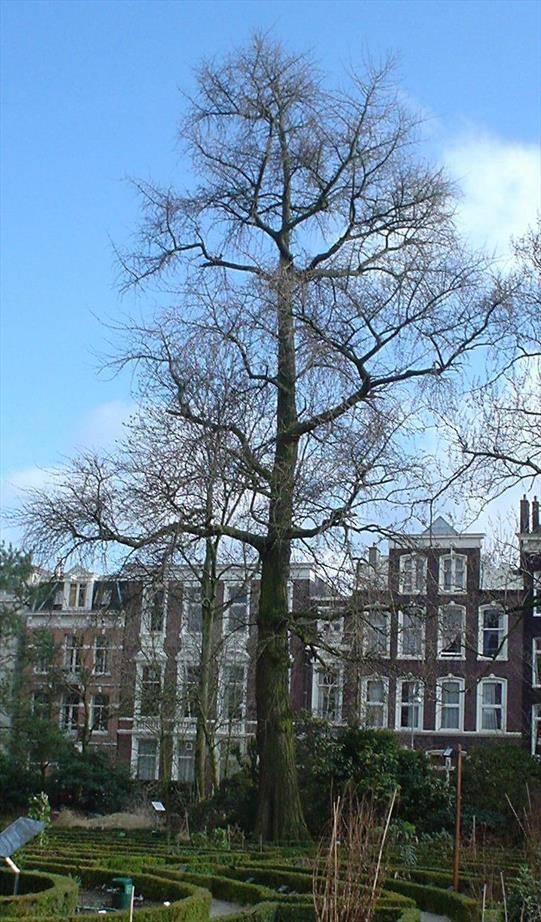
Crown jewel in the Hortus Botanicus Amsterdam, Twickel Estate, Leiden Botanic Garden, Blijdenstein Pinetum, Kerkrade Botanic Garden, Schovenhorst Estate.
Part of the Dutch National Gymnosperm collection.
The seed is sweet with a soft, oily texture and can be eaten raw (in small quantities) or cooked. The baked seed has a taste rather like a cross between a potato and a sweet chestnut.
The characteristic wedge-shaped leaves serve as inspiration for Far Eastern art. Ginkgo was the favourite tree of Goethe who wrote a sonnet about the tree in 1815.
Trees in the wild only grow in the vicinity of temples.
The leaves are use as a treatment to stimulate the blood circulation.
The maidenhair tree belongs to an ancient and primitive order of plants – the Ginkgoales. This order was already growing during the Triassic (ca. 200 million years ago) before the age of the dinosaur and long before modern flowering plants had evolved. It was discovered by the scientific world in Japan in 1691, the tree had obviously been planted and around 1730 it was introduced to Europe. Ginkgo is known as ‘living fossil’, a ‘survivor’ or ‘bearer of hope’. After the 1945 atomic bombing of Hiroshima, Japan, four to six Gingko survivors were found approximately 1-2 km away from the epicentre. These survivors not only survived the blast but they went on to produce buds with no abnormalities.
The seed and soft shell are both slightly toxic.
In China and Japan the tree is considered holy and so for centuries it has been planted around temples.
The fruit have an unpleasant smell and thus female Ginkgo trees are usually not planted.
Champion of antiquity.
Details
| Description: | Conifer, tree, on average 20-35 m, with exceptions up to 40 m. dioecious |
|---|---|
| Distributions: | China |
| Habitat: | Scattered in broadleaved forests up to 1,100 m in altitude. |
| Year cycle: | Perennial (polycarpic decidous) |
| Hardiness: | 5 - 14 f (hardy - cold winter) |
| Flowering period: | April - mei |
| Flower color: | Not applicable |
| Fruiting period: | September - oktober |
| Fruit color: | Yellow, green |
| At its best: | Mei - oktober |
Sources
D. Bensky & S. Clavey & E. Stöger: Materia medica,http://www.conifers.org/gi/Ginkgoaceae.php,
http://www.kew.org/science-conservation/plants-fungi/ginkgo-biloba,
http://conifersociety.org/conifers/conifer/ginkgo/